




Typically, the start of a new year involves a fair bit of future gazing. Identifying trends, collating data and preparing for what might be in store over the next 12 months is a crucial part of the business cycle.
However, the start of 2026 has brought a strong social trend of looking backwards, which very aggressively bucks the understood societal trend of looking forwards.
The social trend, according to BBC reporting from 10 January, originated on TikTok and yielded a 452% uptick in searches for 2016, before 2026 really had a chance to rear its head. This has come in the form of romanticising 2016 for being a time of juxtaposition, where the polarity of Brexit ran alongside the genuine fear of Pokémon GO developers plonking a Vaporeon on your property.
But, was 2016 really a golden age for the industry, as respondents suggested in PRmoment's recent article, 2016 to 2026: what has changed in PR, or is there something to be said for the advancements that can only happen with a decade of change?
Take me back
Sentiments from a recent PRmoment article, exploring how the practical application of PR has changed, revealed that many look back on 2016 fondly, but note that 2026 has brought positive changes such as an increased focus on strategy and measurement, and therefore more clout with stakeholders.
Despite positive changes to the practical application of PR, data from a recent LinkedIn poll has revealed that you are indeed pining for the past.
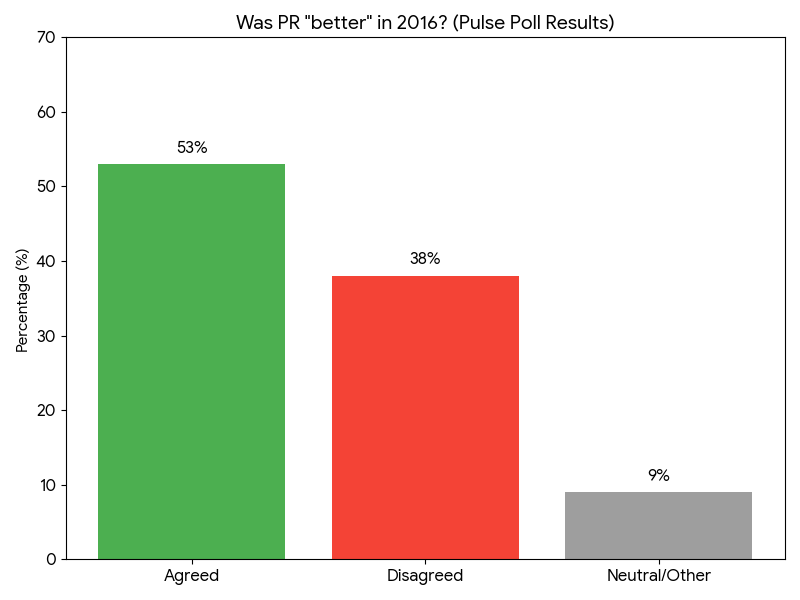
Over 130 PR professionals responded to the three-day poll, asking if PR was “better” in 2016, to which 53% agreed and 38% disagreed.
Indeed, a few respondents hinted that if a DeLorean time machine did exist, they’d go back even further to 2006.
As Claire Bridges, founder and chief consultant at Now Go Create says 2006 was full of, “talking lunches, expenses [and] outrageous client asks”, and Daniel Kennedy, director at Source PR notes that 2006 was “far more fun [with] so much more time on the phone”.
“Give me 2006-2008, which in my head is only 10 years ago. Social media and digital PR [was] in its infancy. [There was] less pressure, and [it was] a fun time to work in the industry.” - Phil Szomszor, director at Brightside Digital Entertainment
Commenting on whether public relations was better 10 years ago, Christopher Fay, associate director at Yap Global says: “Things were more fluid and less scheduled [in 2016] which I think has helped me and others understand how to work flexibly and have the ability to react quicker. Influencers as spokespeople were immediately shot down by the press in 2016, but now get front row access during press conferences. This is a good move in news freedom, of course”.
Connecting in the past
“Back then [in 2016], everything was done in-person. I’d be glued to my phone half the day, and the rest getting into a taxi and on my way to lunch with a journalist or a client. Relationships were expensive but came easy.” - Philip Lacob, account director at Red Lorry Yellow Lorry
Gemma Wilson, director of purpose and strategy at Gold79 says that 2016 felt “full of optimism” which brings memories of “brilliant friends and relationships, noisy news desks, hitting the phones, meetings in person and being out in the real world working on stunts”.
And, Ella Darlington, a B2B tech comms consultant adds a similar sentiment for a loss of connection: “In all honesty, morale at times has been bleak in 2025-6. What’s changed alongside that is how people relate to one another in our industry.
"There's less institutional support, and lots of my peers are leaning more heavily on networks for context, growth, connection and reassurance or, where networks don’t exist that they can relate to, actively building their own. I’ve seen the value of that through my involvement in the G100 Media Arts & Communications UK wing, part of the Women Economic Forum, landed and expanded in the UK by chair Effie Kanyua.”
“In 2016…the industry felt more accessible because relationships were easier to build. You could pick up the phone, meet a journalist for a coffee, and there was a shared understanding of what made a story land.” - Steve Lambert, PR and communications lead at TMPR
But, as Gemma Eccleston, managing director of Hendrix Rose PR notes: "While today’s industry is more efficient and considered, there was something about that period that felt more personal, which probably contributes to why many people remember it fondly, even if the realities were far from perfect."
Greener where you water it
While many practitioners see 2016, as the PR sweet spot, others are able to see that comparison is the thief of joy.
As Chloe Walden, senior partner at Kith&Kind PR reminds that nowadays, PR is more “creative and innovative” and forging relationships requires strategy: “PR in 2016 was different, but not necessarily better.
“Taking the time to earn the trust of clients, creating strategies which align with wider business goals, and maintaining open and honest lines of communication are all crucial to long-term relationships and true success.
"Things have and continue to change so rapidly that now more than ever we need to be nimble and quick-thinking. But, that is what makes it such an exciting time to be in the world of PR and why I wouldn’t want to go back to 2016.”
"If 2026 is all about traversing through a low-trust, high-speed AI accelerated environment, then PR is in for one hell of a ride. This isn’t time to retreat to 2016. The opportunity to be the strategic partners we’ve always sought, has never been more pronounced. This is our year to show why no discipline is closer to the bleeding edge than PR.” - Alicia Solanki, SVP EMEA and UK market lead at Team Lewis
Meanwhile, Jess Schon, founder and managing director of Schon&Co highlights the benefits for independent PR agencies: “PR wasn’t better in 2016, but it was different. Over the past decade, the industry has grown up: it’s more accountable, more human, and far more focused on outcomes.
“Without rigid corporate boundaries, we [independents] can be professional and results-driven while still being warm and personable. As research consistently shows that trust is built on warmth before competence, it’s no surprise that this has become a defining value for modern PR and makes the industry better today."
Keep it real
“Authenticity and connection were important in 2016 but not to the level that it matters now.” - Jade Emmons, communications director at Skillable
Notably, an overwhelming majority of commentators applauded the move away from 2016's staged content, oversaturated influencer market and lack of authenticity — which is now in complete opposition to what audiences in 2026 crave.
Jack Rigby, founder of The PR Barn says that in 2016 PRs were "falling over themselves" to bag cost-efficient influencer results, but in 2026 were are now "close to saturation point" as people lean towards "genuine voices" over staged content.
"In a world riddled with deepfakes, bought followers, and engagement circles, this start at home approach builds stronger relationships with a brand’s community and acts as a stepping stone to earned media," says Rigby. "Perhaps human instincts are kicking in and we’re returning to our tribes after exploring the world through others’ eyes and not always liking or believing what we see.”
"Authenticity has moved from being a brand claim to something far more tangible; a lived extension of a brand that audiences can observe, assess, and relate to over time." - Antara Khaund, PR executive at Ampa Group
This shift, according to Fran Ashcroft, senior director EMEA communications at Intel is because the media landscape of 2026 is much changed. "Since [2016], turbulence has accelerated," Ashcroft explains.
"Change is constant, scrutiny is permanent. Traditional media now sits alongside creators, communities and critics. Audiences are fragmented, attention is scarce, and everyone has a platform. Information flows faster, stories spread instantly, and the landscape is less predictable than ever. PR’s role has shifted. It’s no longer just about placing stories. It’s about helping organisations navigate complexity in real time, turning fast-moving issues into clear, human stories people can trust."
The verdict
The overall verdict is a mixed bag. While the majority of the industry would like to return to 2016, the fact remains that PR has grown as a function and is now an absolutely vital part of any brand or business strategy.
Lorraine Emmett, MD at EC-PR reminds: "Between 2016 and 2026, PR has evolved from a media-led function focused on coverage to a strategic discipline centred on trust, visibility and long-term influence.
"PR now supports the buyer journey earlier, shaping decisions before sales engagement. As a result, PR has moved from a tactical support function to a strategic capability that builds trust at scale and delivers lasting competitive advantage."
"Communications has become a discipline that shapes decisions from the outset. The rise of chief communications officers as indispensable advisors to CEOs and boards reflects this shift." - Roisin Miller, director at Porter Novelli
And, while we may wish to bring back some of 2016's lightheartedness, Sophie Charlotte, advisor at sophiecharlotte.strategy concludes that we simply cannot go backwards: “Over the years public cynicism has only intensified, and for good reason. Companies have to be able to demonstrate that they treat their staff and the world at large as well as their brand would have you believe they do. Personally, I am of the view that unless you, as a B2C brand, corporate entity or institution, are actually doing something to make the world a better place in this climate, I think I speak for most of the general public when I say, 'shut up and get back to selling your product'.”
If you enjoyed this article, sign up for free to our twice weekly editorial alert.
We have six email alerts in total - covering ESG, internal comms, PR jobs and events. Enter your email address below to find out more: