





If you feel like you are being inundated by AI at the moment, you’re not alone. It seems that every time we open our phones, turn on the radio, read the news or even talk to friends, the conversation inevitably turns to AI.
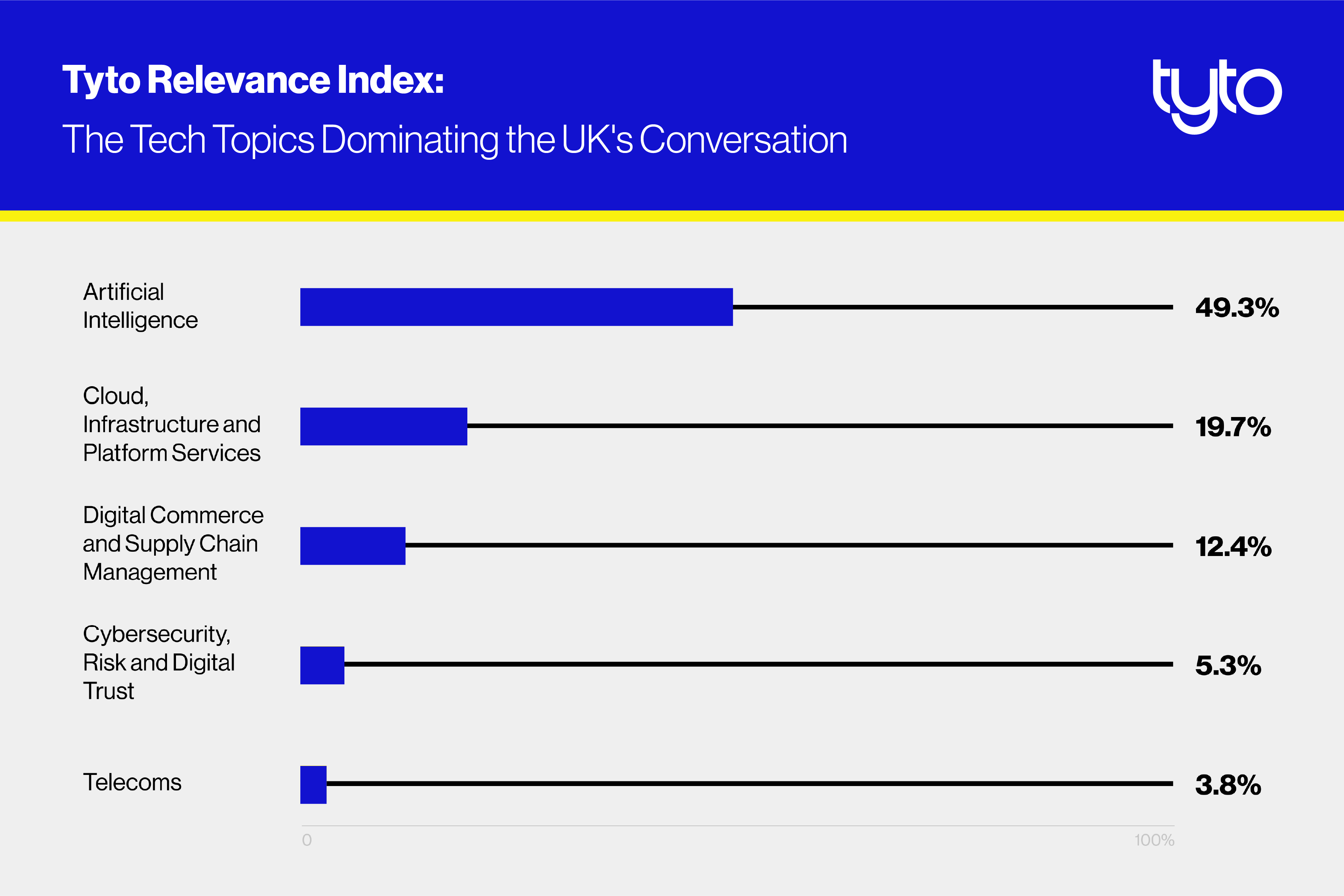
It’s not just a feeling, it’s a fact. Tyto’s analysis of more than 250,000 media mentions and social media posts revealed that AI now accounts for half (49.3%) of all tech discussions by industry influencers in the UK.
This AI-driven "category collapse" has widespread consequences for comms teams, as companies aren’t just competing for attention within their own category, but within the wider tech sector too. To stand out and stay relevant amid all this noise, companies must offer a distinctive narrative on AI.
All roads lead to AI
Tyto’s Relevance Index is an annual analysis of ongoing technology discourse in Europe. By understanding what the most influential voices are discussing, comms professionals can direct their efforts towards the leading edge of the conversation, where attention is building, and get ahead of the competition.
Organisations, particularly in tech, are embedding AI at such a proliferation that it is no longer a standalone topic but instead a consistent theme across the whole sector. As conversations across once distinct categories converge, we’re seeing a single conversation emerge around AI.
The scale of this is evident if you consider the other most discussed tech categories in the UK: cloud is mentioned in 19.4% of tech conversations, digital commerce and supply chain management in 12.4%, cybersecurity in 5.3% and telecoms in 3.8%. They are all dwarfed by the AI conversation at large, plus AI also accounts for a considerable share within each of these conversations too.
Regional context matters
It is important to note that this is not a uniform story across Europe. The UK is well above the European average of 40%, making it the most AI-focused region when compared to The Netherlands (39.8%), France (33.7%), and Germany (30.2%).
While AI is the common thread, regional context still shapes distinct narratives. For example, policy remains a strong topic of influence in EU countries, and AI is frequently discussed within national conversations on regulation, governance, security and trust.
It is also interesting to observe the influence of global tech companies on the local conversation. Over two-thirds of the organisations referenced in the media and social media posts by industry influencers are headquartered outside of Europe, notably 60.7% in the US. This tells us that discourse is primarily being driven by American Big Tech – like Google, OpenAI and Microsoft – with the rest of the industry following their lead.
Aligning strategies to influence
We are then left with the question: "What does this mean for communication teams?" Any organisation with a credible AI story can attract attention and shape the discourse. The challenge is that having an AI story is no longer enough.
Historically, companies largely competed for attention within their own category. Today, a cybersecurity company, a cloud provider and a fintech one may all find themselves competing within the same AI-driven conversation.
The question is no longer whether your organisation should talk about AI, but what distinctive perspective it brings to the debate.
What’s more, that narrative must have a coherent thread across all markets, but should be adjusted to local nuance. The way in which AI is spoken about in the UK media differs to other European media, and a robust communication strategy will flex accordingly. The AI narrative that you develop should reflect the more prominent concerns – governance, risk and trust need to be fundamental pillars not an afterthought.
At the same time, the conversation itself is maturing. Much of the debate has shifted from what AI could do, to how organisations are actually deploying it and the value it is delivering. That raises the bar for communications teams. Broad claims about being AI-powered are becoming less persuasive when every company is making them.
The organisations that cut through will be those that can demonstrate tangible outcomes, whether that is productivity gains, customer impact, stronger decision-making or better business performance. In a crowded market, proof increasingly matters more than promise.
Category collapse is ultimately an attention challenge. When every company is competing in the same conversation, differentiation comes less from participation and more from perspective, credibility and evidence. The organisations that succeed will be those with a clear point of view on AI and the proof points to back it up.
If you enjoyed this article, sign up for free to our twice weekly editorial alert.
We have six email alerts in total - covering ESG, internal comms, PR jobs and events. Enter your email address below to find out more: