






GEO has given PR a new measurement problem. You’ve heard it all before, “people are no longer only searching, clicking, reading and forming views in ways we can easily track Increasingly, they are asking AI tools to summarise, recommend, compare and interpret information on their behalf.”
That is a pretty spectacular departure on how organisations are found and understood, leaving many PRs and marketers scratching their heads. It also changes what communicators need to measure. If a potential customer, investor, policymaker, journalist or employee asks our new AI overlords about an organisation, what comes back? Is it mentioned? Is it described accurately? Are credible sources cited? Are important facts missing? Are old claims repeated without context?
These are now legitimate PR measurement questions, but don’t fall asleep just yet if you think measurement is not your job and you do, you know the “creative bit”, because measurement shapes practice, and if you know how to measure it you know how to do it. Just work backwards.
But these exciting new PR toys require discipline. The danger is that GEO, or Generative Engine Optimisation, becomes the next measurement shortcut: a dashboard, a score, a league table and a false sense of certainty. I also hear your company’s accountant growning under the sheer weight of yet another software subscription.
The AMEC GEO Principles
The AMEC GEO Principles were developed to prevent that, well except the software subscription bit. The work came through AMEC’s Agency Group over more than six months, with board scrutiny, practitioner feedback, vendor discussion and industry consultation.
Authors of the work included me, James Crawford of PR Agency One, Mary Elizabeth Germaine of Ketchum, Ben Levine of FleishmanHillard TRUE Global Intelligence, Matt Oakley of Hotwire Global, Amber Daugherty of Big Valley Marketing and Rob Key of Converseon. The point was not to create a proprietary method, but to bring rigour, transparency and governance to a fast-moving and commercially noisy area.
The seven principles are deliberately grounded in established communications evaluation.
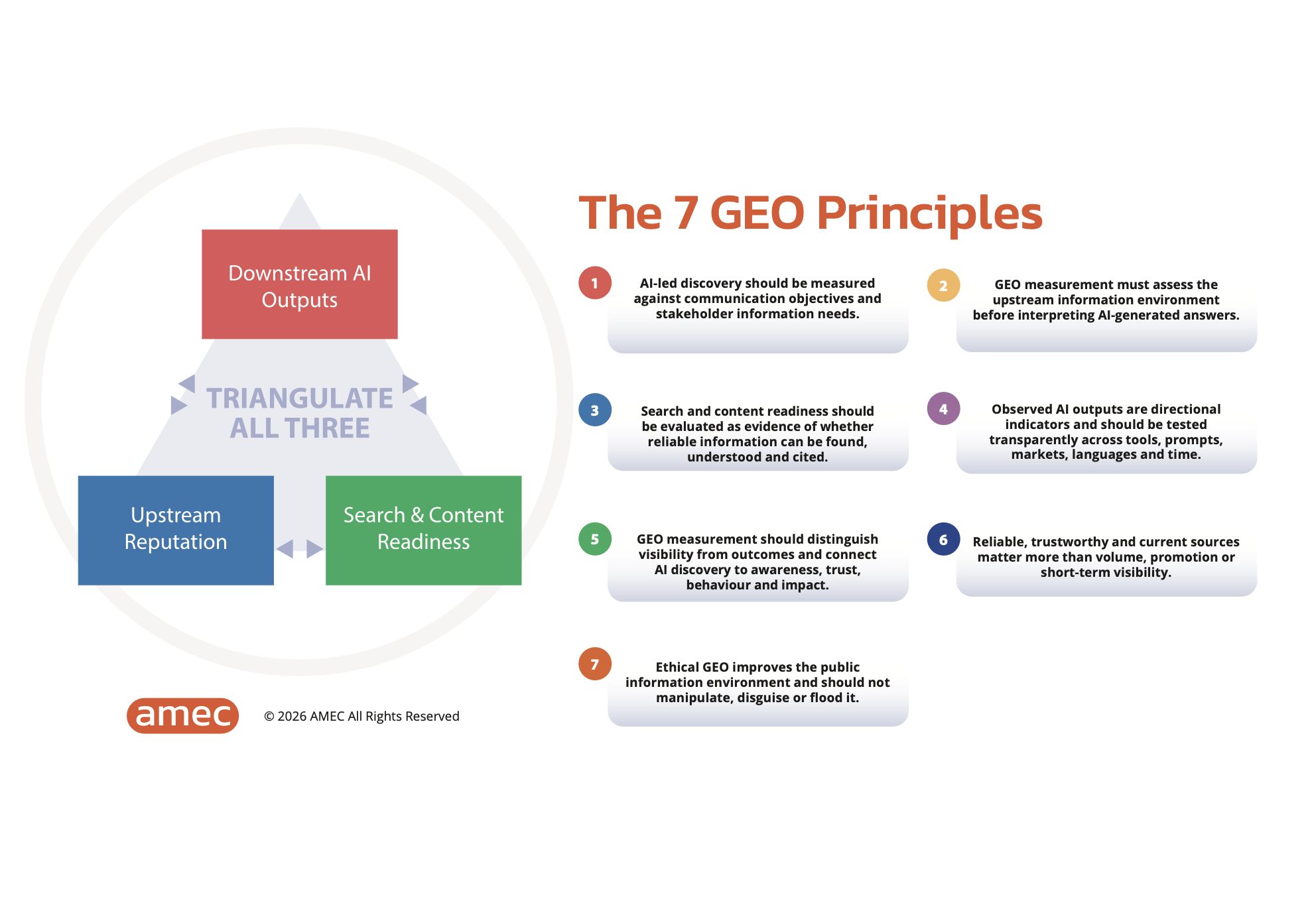
They start by saying that AI-led discovery should be measured against communication objectives and stakeholder information needs.
In other words, the first question should not be, “are we visible in AI?” It should be, “what do our audiences need to know, and are they encountering information that is accurate, useful, current, credible and trustworthy?”
The second principle says GEO measurement must assess the upstream information environment before interpreting AI-generated answers. AI systems draw on the public record around an organisation: earned media, reviews, expert commentary, public records, stakeholder discussion, social content and owned pages. If that record is inconsistent, thin or out of date, AI-generated summaries may reflect those weaknesses.
The third principle focuses on search and content readiness. Reliable information needs to be discoverable, structured, current, accessible and supported by credible sources. This is where PR, search, content and reputation management begin to overlap. The question is whether trusted information can be found, understood and cited.
The fourth principle deals with AI outputs themselves. Observed results should be treated as directional indicators and tested transparently across tools, prompts, markets, languages and time. Outputs fluctuate. Retrieval and citation behaviour changes. Prompt wording affects results. A single answer from a single tool at a single moment is not a measurement framework. There are some great tools out there for this but don’t rely on them on their own.
The fifth principle is crucial: GEO measurement must distinguish visibility from outcomes and impact. Being mentioned in an AI answer does not prove awareness, trust, preference, behaviour change or commercial value. PR has spent years arguing that outputs are not outcomes. We should not abandon that discipline because the interface has changed.
The sixth principle says reliable, trustworthy and current sources matter more than volume, promotion or short-term visibility. That should be a warning to anyone tempted to flood the web with weak content in the hope of influencing machines.
The seventh principle is the ethical guardrail. GEO should improve the public information environment. It should not manipulate reviews, disguise promotion as independent evidence, or treat AI outputs as factual without verification.
The companion Practitioner’s Guide aims to simply these principles and given us an accessible approach for practitioners, by showing how to apply those principles through three triangulated evidence sets.
The first is upstream reputation: the earned, shared, owned and third-party information environment that AI systems may draw upon. The second is search and content readiness: whether reliable information is findable, structured and credible enough to be retrieved or cited. The third is downstream AI output tracking: what users may actually see, including presence, prominence, framing, citations, omissions, accuracy and risk.
None of these evidence sets is enough on its own. Upstream reputation shows what exists. Search and content readiness shows whether it can be discovered. Downstream output tracking shows how information may be presented in AI-led environments. Together, they provide a more credible basis for judgement.
Do it once, do it right
The practical standard should be simple: do it once, do it right.
That means building governed query libraries linked to stakeholder questions. It means documenting tools, prompts, platforms, dates, markets and languages. It means repeat testing, saving outputs as evidence, reviewing source quality and keeping a risk log. It also means being honest about limitations: no single score, tool or prompt set can prove total AI visibility or communication impact.
GEO adds new evidence to PR measurement, but it does not rewrite the rules of evaluation. Outputs, out-takes, outcomes and impact still matter. Where referral data exists, analytics can help. Where reputation, trust or consideration are the objective, audience research still has a role.
The opportunity for PR is significant. We understand reputation, authority, trust, public narrative and third-party validation. Those skills are becoming more valuable in AI-led discovery, not less. But only if we measure with rigour.
GEO measurement will not be solved by vanity scores or black-box dashboards. It will be advanced by transparent methods, professional judgement and the confidence to state what the evidence can and cannot prove. In a noisy market, credibility will come from rigour, transparency and restraint.
Hopefully the whole industry benefits from the creation of the AMEC GEO Principles and they go some way to further cement PR’s leading role in GEO practice.
James Crawford chaired the writing of the AMEC GEO Principles and is a board director at AMEC.
If you enjoyed this article, sign up for free to our twice weekly editorial alert.
We have six email alerts in total - covering ESG, internal comms, PR jobs and events. Enter your email address below to find out more: