



A survey of senior marketing leaders across the GCC revealed that 57% of CMOs identify brand equity and long-term loyalty as the primary drivers of sustained growth, yet 72% say their current focus remains on short-term performance metrics.

"There is clear alignment on what drives long-term growth, but the way marketing is measured hasn't caught up," said Charli Wright, CEO at JWI. "Marketers are being asked to deliver immediate results while also building long-term value. That tension is shaping day-to-day decisions."
Knowledge gap vs. Governance gap
The framing that has dominated initial coverage of the report focused on the brand-versus-performance tension as a strategic challenge for CMOs. But the data suggests something more specific: the problem is not that marketing leaders lack conviction about what works. It is that the organisations around them are not structured to support it.
This is important to note, as a knowledge gap can be addressed through education or persuasion, while a governance gap requires structural change – in how marketing is measured, how investment decisions are made, and how the CMO relates to the CFO and CEO.
The evidence that this is a governance issue, not a mindset one, is growing globally. The most recent edition of The CMO Survey, based on 308 marketing leaders at US companies, found that pressure from CEOs, boards, and CFOs is directly driving short-term focus as 70.6% of marketing leaders reported shifting toward short-term impact over long-run gains in direct response to that pressure. The CMO-CFO partnership, meanwhile, has barely moved in four years, rated just 4.5 on a 7-point scale for building a business case for marketing spending, with fewer than half of companies reporting that marketing and finance work together on growth.
The NIQ CMO Outlook: Guide to 2026, based on responses from more than 250 senior marketing decision-makers across regions, revealed that only 69% of CMOs say their CEO and CFO support long-term brand investment, a sharp decline from 80% the previous year. In the same report, 84% of CMOs said ROI is now their primary metric for budget allocation highlighting where the pressure originates from, rather than where CMOs themselves believe investment should be directed.
The measurement problem
Central to the governance gap is infrastructure that was not designed to measure long-term brand value. As The Trade Desk's Lukas Fassbender wrote in a February 2026 analysis for The Current: "CFOs do not challenge brand investment because they want to. They do so because they cannot see it clearly in the numbers." The piece cited data showing only 22% of marketers saying they can confidently justify their value to their CFO with the data they currently have, and 64% saying demonstrating financial impact remains their single biggest challenge.
This creates a compounding dynamic as typically, what is measurable gets funded. With what gets funded getting prioritised, over time, the metrics that are easiest to capture – clicks, conversions, short-cycle performance data – come to define what marketing is understood to be, rather than what it can do.
The tenure problem
There is also a structural reason the gap between belief and behaviour persists over time, related to how long CMOs stay in their jobs. CMO tenure among S&P 500 companies now stands at 4.1 years, according to Spencer Stuart data published by Adweek earlier this year, the lowest in more than a decade, and well below the C-suite average of five years or the CEO average of 7.6 years. Forrester research published in August 2025 found that over one in five Fortune 500 companies changed marketing leadership in the previous 12 months, with CMO presence in the C-suite falling from 63% to 58% of companies. This results in new marketing leader inheriting a system they did not build, and having to optimise under short-term pressure.
The JWI findings do not include tenure data for GCC markets specifically. But the broader pattern is relevant as consistent turnover adversely affects sustained action.
What this means for communications
Brand trust and cultural relevance ranked joint second among CMO priorities in the report, cited by 50% of respondents. But, the structural conditions that would allow sustained investment in reputation – consistent presence, long-term messaging, relationship with communities – are ultimately what gets squeezed when short-term performance pressures dominate.
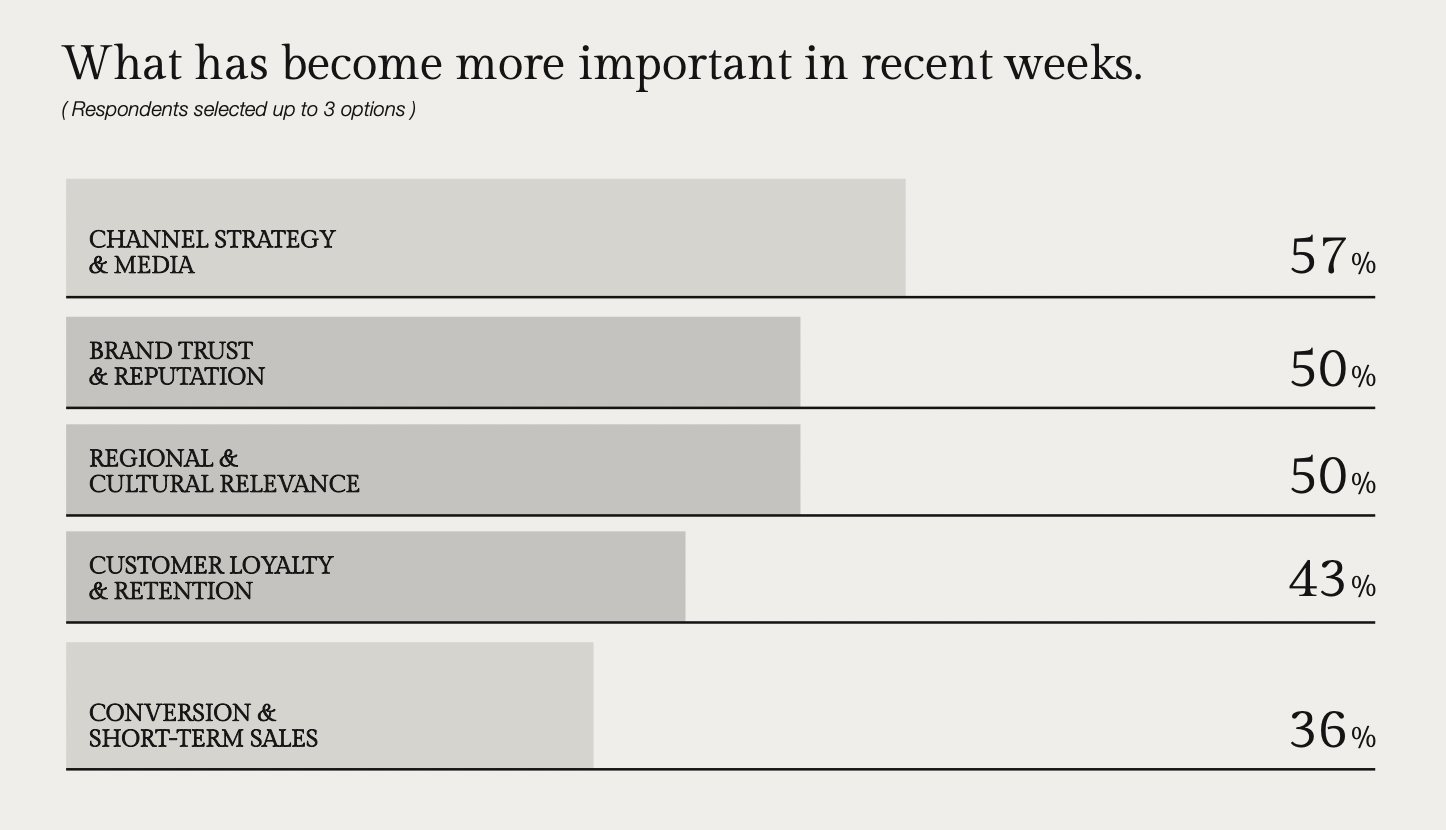
The report also found that 36% of CMOs have adjusted tone and messaging in response to current conditions, and a similar proportion have increased their focus on customer communications. So, while brands are not going quiet, they are having to manage between what they need to do long-term and what they are resourced to do right now.
JWI's report is explicit on this point. "The most resilient brands are not those that respond fastest," it states, "but those that have built clarity, consistency and trust over time."
The bigger question
The JWI report ends with a question that the data itself raises: will organisations act on what their marketing leaders already understand, or default back to familiar patterns once the immediate pressure ceases?
Globally, the evidence suggests the default is hard to break. Gartner research published in December 2025 found that half of CMOs identified short-term needs versus long-term strategic planning as their biggest challenge, highlighting how organisational level pressures are more impactful than the ambitions of the leaders themselves.
Within the GCC, the region's largest brands have built significant equity over relatively short timelines, in markets where cultural relevance and trust carry significant commercial weight. And while that equity is an asset, it needs conditions to be better maintained and grown.
To stay in the know, follow PRmoment MENA on LinkedIn here. You can also subscribe below to our weekly newsletter.