





Headlines about ESG backlash and businesses deprioritising environmental commitments could lead you to believe that sustainability-led marketing is dead. Or, at best, it’s dying.
But this narrative is at odds with what, for many brands, is a significant commercial opportunity. There’s a high-spending, fast-growing consumer group quietly spending in line with their values and for whom sustainability is a baseline expectation. We’re calling them Gen G.
Gen G is a term that was born out of a data project we ran with Bombe – an AI-driven platform that can predict revenue and consumer behaviour with 90% accuracy – which aimed to explore the extent to which sustainability still ‘works’ as a marketing tool. We could see the changing mood about sustainability amongst many in the business community.
The word itself has picked up cultural baggage, being perceived as worthy or woke in some circles. Indeed, our Building a Better World report, released towards the end of last year, discovered that many organisations are in a state of ‘purpose paralysis’, where fear of doing the wrong thing means they do nothing at all. But there’s evidence that this position doesn’t reflect the consumer reality. Building a Better World found that 98% of UK consumers want brands to act on issues that matter. Furthermore, the rapid rise of the Green Party points to the cultural relevance of a values-led consumer that wants better for people and planet.
With Bombe, we delved deeper into this environmentally minded cohort and their spending behaviours.
Bombe’s data defines Gen G as consumers for whom the ethical position a brand takes is the biggest factor impacting their spending. They’re willing to pay more for goods and services that put people and planet first.
Gen G represents around 10% of UK adults. They’re far from anti-capitalist; in fact, they’re the second highest-spending consumer group in the UK, with Bombe’s modelling predicting they’ll take the top spot by 2030. They’re ten times more likely than other groups to spend money on experiences and lifestyle products, making them a powerful driver for growth.
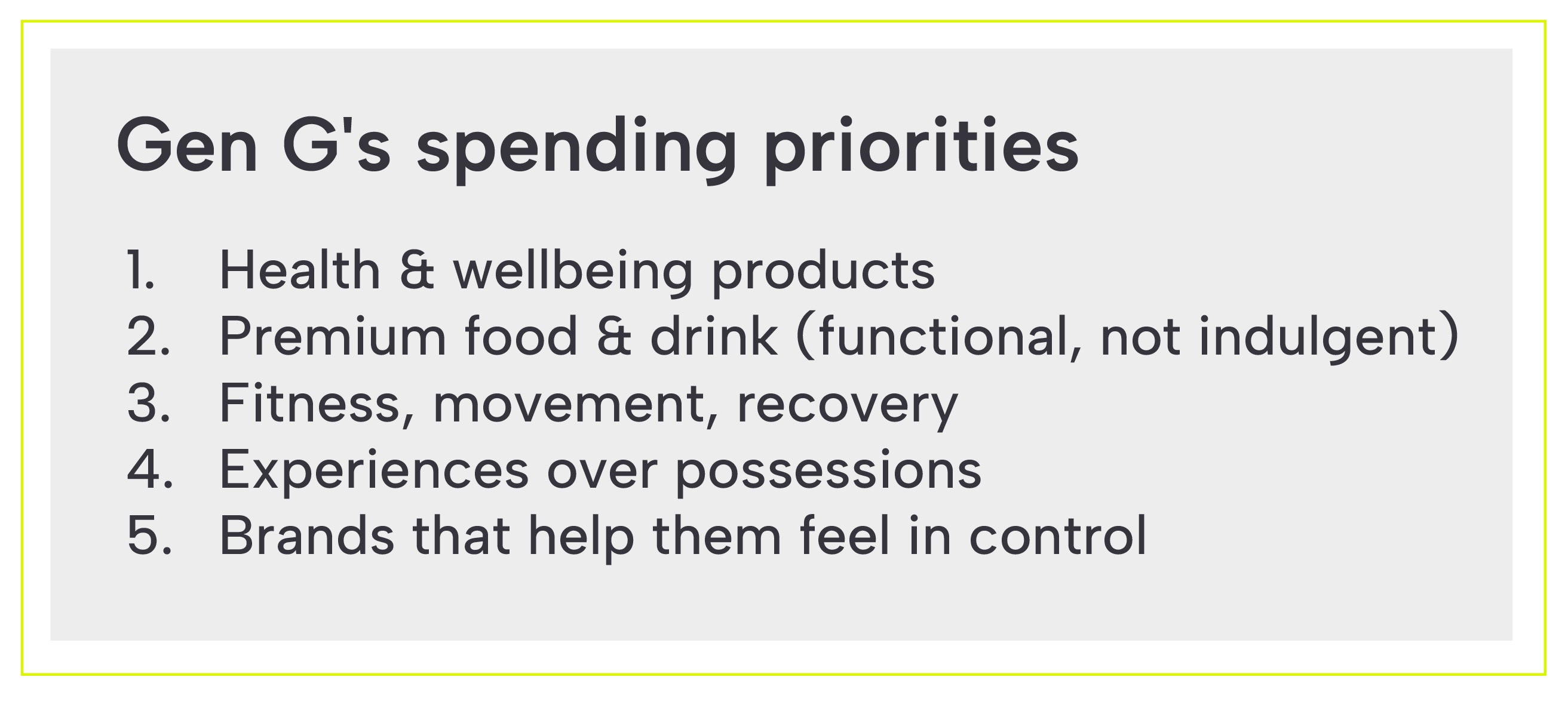
They prioritise spending on five areas:
- Health and wellbeing – longevity over aesthetics, with sleep, gut health and anxiety being key areas
- Premium food and drink - functional, not indulgent, with a focus on ritual and craft
- Fitness, movement and recovery – optimisation is a key area of interest
- Experiences over possessions
- Brands that make them feel in control of their lives
Although Gen G is a mindset rather than a demographic cohort, there are common characteristics. Many are early-career professionals and students between the ages of 18-34. They’re likely to be working full-time or studying alongside work and are less likely than other groups to have children. They tend to be urban renters, with ownership aspirations, concentrated in London, Brighton, Bristol, Manchester and Leeds. They’re relatively affluent, typically earning £34k+ with a strong segment at £48k+.
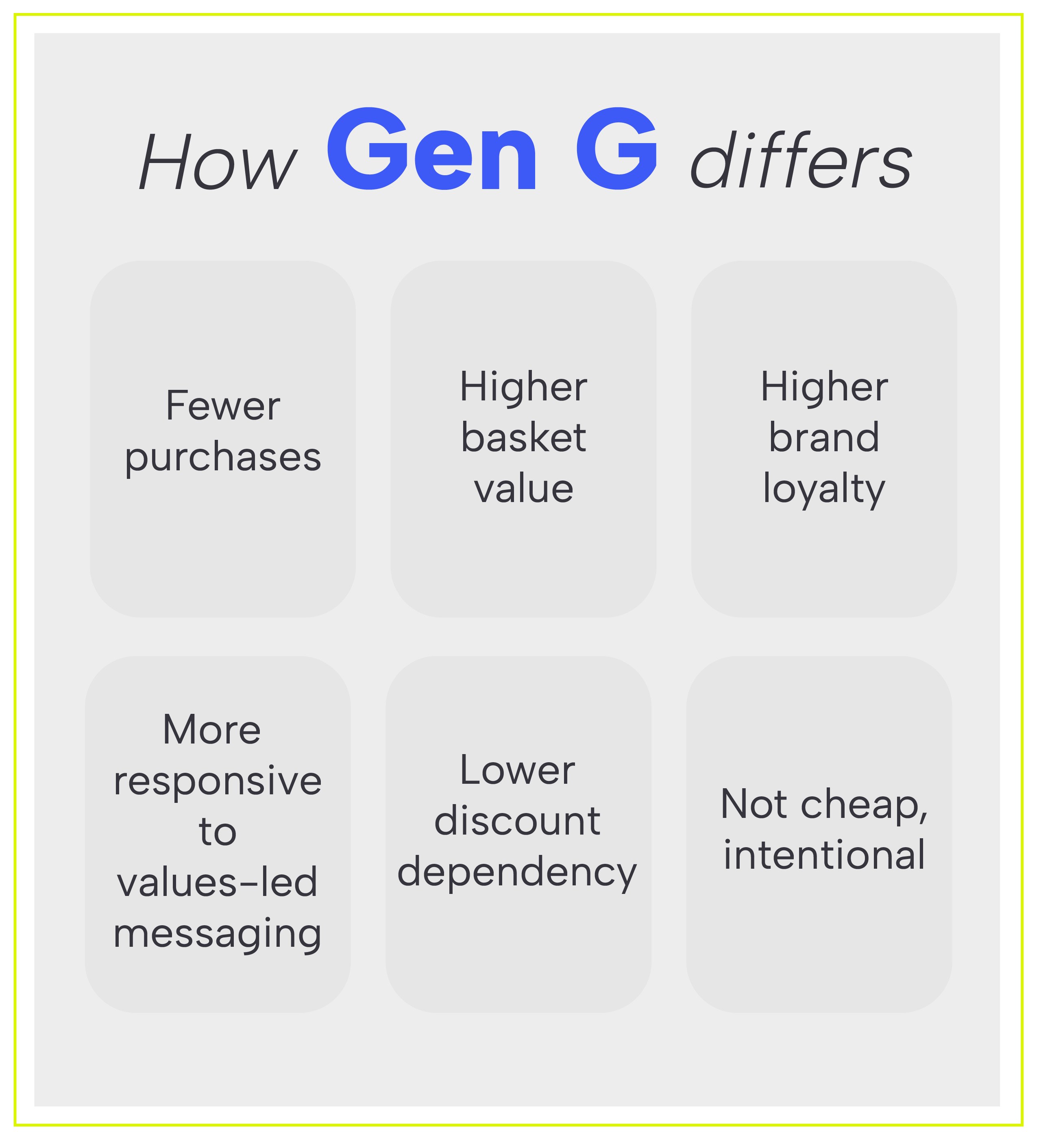
To communicate with Gen G, brands need proof over promises. Here’s what works:
Lead with personal benefit
Make sure you can answer the question, “how does it improve my life?” Think in terms of optimisation and functional benefits. Position spend as intentional, emphasising quality over price.
Provide the receipts
Green claims should be evidenced with specific data, sources and outcomes. Gen G expect sustainability as standard so make it a given, rather than a headline.
Create credibility
Take an expert tone and dial down the hype. This audience wants to be educated through useful content. They respond well to communications designed for depth and discovery, from TikTok to podcasts.
With Bombe, we’ve launched a new offer – the Gen G Growth Lab – which builds on these insights with a bespoke roadmap designed to show brands where Gen G demand exists for them (by persona and geography) and how to convert it through communications. This product helps brands market themselves in ways that will appeal to Gen G, against a changing landscape for sustainability.
It’s clear that sustainability-led marketing isn’t dead, but it needs to change. Consumer ethics haven’t disappeared. Amongst G Gen, they’ve become embedded. To unlock growth from this growing group of consumers, brands need to embed these values too.
Written by
Sharon Bange, Co-MD at Kindred.
If you enjoyed this article, sign up for free to our twice weekly editorial alert.
We have six email alerts in total - covering ESG, internal comms, PR jobs and events. Enter your email address below to find out more: