





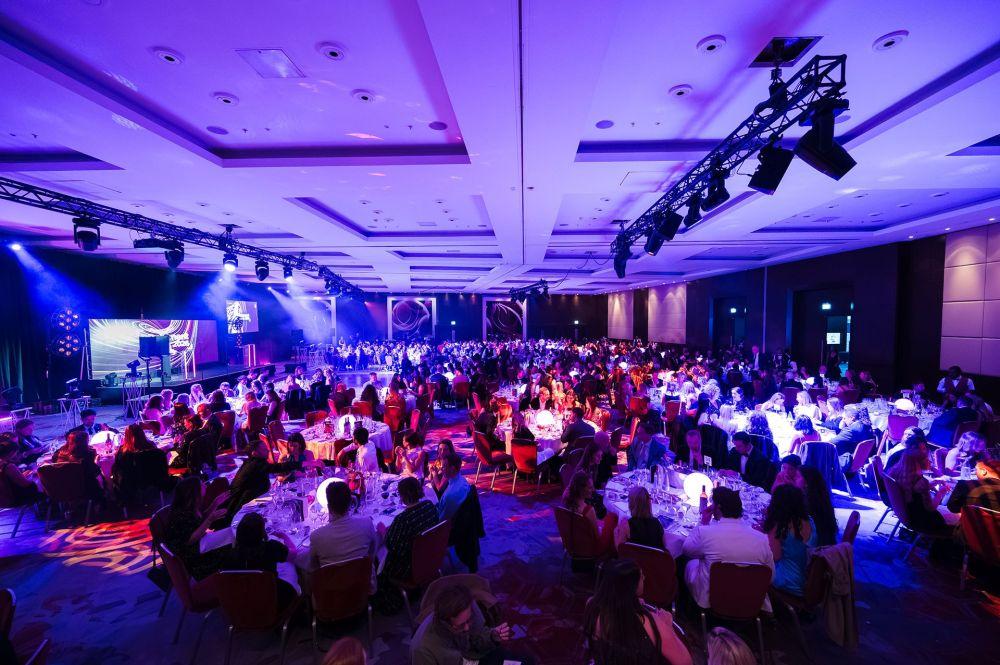
As winners of the recent PRmoment Awards in London and Manchester bask in their hard-fought recognition, our expert panel are here to guide you on how to make your next entry truly unforgettable.
While you might have to wait until November 2026 for entries to open for The PRmoment Awards, it’s always a good time to brush up on your entry statement skills. And, with the Creative Moment Awards 2026, maybe your writing talents will be called on sooner than you think?
One thing’s for sure, however, gathering with your team mates on stage to celebrate the ultimate acknowledgment of your PR efforts ranks among the most satisfying personal accomplishments, and one of the most powerful forms of marketing a business can achieve.
The winners' stage might just be a few small steps from your table, but the journey to getting to that point is considerably less simple.
A (quick) look back at our recent PRmoment Manchester Awards
@prmomentuk Highlights from an incredible night in Manchester last night celebrating the PR scene in the north. #awardseason #awards #pr ♬ original sound - PRmoment
Writing an entry demands investment in time, energy, and resources. So to maximise efficiency, and stand a fair chance of walking off with that coveted silverware, our panel of founders, PRmoment staffers and seasoned judges reveal how to perfect your prose.
Only accept the exceptional
Our expert panel is surprisingly consistent on a few things. Foremost is that the campaigns that win are not necessarily the biggest or the most expensive, but rather the sharpest, most coherent, and the best substantiated.
But, before you even consider opening the submission portal, the first step is honesty.
As PRmoment Awards judge, Elly Kestenbaum, partner at Tin Man, admits: "You know when you’ve got a trophy-worthy campaign on your hands; you can feel it in your bones". These are the campaigns that practically write themselves, ticking every box with confidence.
But, she argues, there’s a commonality in what makes the judges stand up in their seats. She defines this as "simple but genius": the creative idea that makes you think “'why-has-this-never-been-done-before?”. In practice, this means a campaign that can be "described and understood in a line", delivered with a perfect execution and with results and impact that were out of this world.
"There’s no point trying to craft an entry about a mildly successful campaign because it’ll show in the write up, so save yourself the money," Kestenbaum advises. "Only pick the best of the best."
This quality control is crucial, according to Will Hart, CEO of PRmoment Leaders, who adds that, when assessing campaign award categories, judges "want to see a fantastic idea at the heart of the story". They also want to see “great results, properly measured and tied to wider business objectives”.
The judging community also touched on the requirement for a clear and credible 'red thread' in your entry. This throughline must seamlessly connect the initial problem, the strategic insight, the campaign idea, and the final, measurable outcome.
Andy West, founder of Westofcenter, stresses an emphasis on structural discipline: "Winners make it easy for us judges to see what the brief was, what success looked like and how it was delivered".
This starts, he argues, with a robust explanation of the client challenge and, importantly, the desired business outcome, rather than just a list of communications activities. "Winning entries are not necessarily the flashiest campaigns or the ones with the biggest budgets. They are the ones that are clearest, most disciplined and best evidenced".
A campaign's strategy must be deeply rooted in evidence. West says this could be audience data, market context, or behavioural insight. Such rigour ensures a bit of meat is put on the campaign idea’s bones.
The entries’ logic should flow, it should be easy to grasp, and clearly linked back to the original brief.
The award entry nuts and bolts
A brilliant idea, however, is only half the battle. The practicalities of the submission must be flawless, especially regarding objectives and results.
Siân O’Keefe, founder and director of Salient Communications, notes that winning entries "make it easy for the judges to understand the problem, issue and challenge that their work needed to address" and what the team did to achieve this. She is particularly focused on objectives "both in terms of communications (e.g. coverage, sentiment) and the business outcomes (e.g. increased sales by 5%)".
This focus on business impact is also a non-negotiable for West, who warns against relying on vanity: "Just saying ’We got lots of coverage’ is not enough. The best entries show how the work drove real business impact, whether that is sales, leads, market share, enquiries or a measurable shift in behaviour."
This data, he adds, should be a "mix of quantitative and qualitative evidence" to be truly persuasive.
Ben Smith, founder of PRmoment, shares his judging insights, emphasising how vital the results section is: "It depends whether it's a campaign entry or a team entry. For campaign entry, very simply, it always comes down to the work. Great work has a chance of getting shortlisted and winning.
“Relevant objectives, great strategy, great creative, great activation and great measurement are all important. But in the end it all comes down to the work. I would add that if you don't include a budget, it makes it very difficult for the jury to judge. No one's going to mark you down for having a big budget or a small budget, but it's an important context to have when assessing entries."
The art of storytelling
Once the strategic clarity and rigorous data are in place, the "awards magic" comes into play, namely the ‘storytelling and personality’. This can elevate a strong entry into a truly unforgettable one.
Hart describes a captivating entry as "one in which the authors approach it with all the focused attention they’d bring to their best work for their clients. PR, after all, is all about earned-first storytelling, and the awards entry is the moment to shine by telling our own stories. Winners seize that opportunity to the full."
The tone also matters immensely, and Hope&Glory co-founder James Gordon-MacIntosh offers guidance on good storytelling: "I always think a great award entry should have the tone of a story well-told in the pub. Keep it simple, keep it clear and make me smile."
An entry, he adds, "needs to read like a story", while balancing the requirement to be short. "Keep the idea simple – I want to be able to understand the idea in two sentences – or five words ideally. Keep the extraneous details out because I don’t need to know the trials and tribulations of execution of the campaign, I want to know how remarkably successful it was. This is the ‘swan on the lake surface’: don’t show the legs that paddled beneath the waterline.”
Giving it a final polish
The final step involves actually reading the awards criteria, and showing a discipline in following the process and respecting the judges' time.
O’Keefe says that strong entries often demonstrate additional excellence, such as work that "demonstrate boldness, creativity or innovation," "achieves great results on a shoestring budget," or "achieves cut-through in an area/topic that is not immediately exciting or attention grabbing".
She also highlights how important it is to provide future context, with entries showing how teams plan to build on their success for future campaigns, or sharing their approach/lessons learned.
Entry non-negotiables
Follow the structure. Use the official PRmoment Awards entry form as a guide, even if you are not submitting via the form itself. Gordon-MacIntosh stresses simply: "read the entry rules".
Target the category. Gordon-Mackintosh recommends tailoring entries to categories, stating: "There is a requirement to write for the category. It’s often overlooked as a discipline".
Make use of the ‘Why You Should Win’ section. O’Keefe advises entrants to use this section "to include a new nugget of compelling information rather than reiterating information already shared".
Proofread without mercy. O’Keefe insists on this basic: "Proofread your entry, and ask a colleague (or someone who wasn’t involved in your work) to proofread your entry, too, to ensure that the purpose of your work and the great results it delivered are clear (and that all spelling and grammar is correct!)".
In today’s age, the human element, as a final point, should not be overlooked. As Sharp says: “Judges are tired humans". She boils this down to a golden rule: "Clarity wins. Brevity wins. Personality definitely wins." Effectively, the easier you make the submission to read, the higher your chances of success.
This focus on quality writing and clarity is echoed by West: "Award writers need to obsess over the quality of writing because clarity beats cleverness every time".
Ultimately, the path to the podium is paved with discipline, rigorous data, and a compelling, well-told story.
If you enjoyed this article, sign up for free to our twice weekly editorial alert.
We have six email alerts in total - covering ESG, internal comms, PR jobs and events. Enter your email address below to find out more: