




Lesbian Visibility Week is meant to do exactly what it says on the tin: make lesbian voices and experiences more visible. So when our latest ad, created to highlight lesbian pleasure, was rejected by mainstream media owners, the ironic contradiction is hard to ignore.
At Lovehoney, we set out to mark the week with creative developed by and with Queer and lesbian voices, designed to challenge the clichés that continue to define how lesbian sex is understood, or more accurately, misunderstood.
Using a series of optician-style eye tests, the creative invited people to look closer. And if they did, they’d see something rarely given space in public; honest, witty reflections of real lesbian experiences.
Lines like “We are so much more than scissoring” and “Long nails don’t need to get in the way” weren’t written for shock. They were written because they’re real, rooted in lived experience, not filtered through a heteronormative lens.
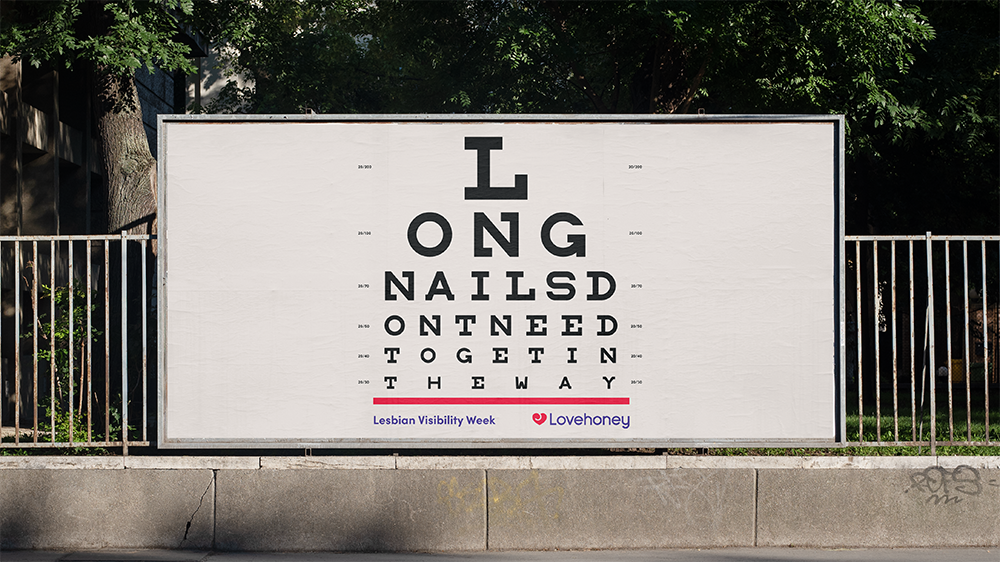
The plan was for this to run across out-of-home channels during the week, alongside placements in LGBTQ+ venues and on social media. But while the campaign is now live in community spaces and online, media owners rejected it for OOH.
We recognise that sexual wellness advertising operates within stricter guidelines. This campaign wasn’t designed to be immediately explicit; its meaning reveals itself on closer reading. This raises questions about which expressions of sexuality are allowed space in public view and in short, a campaign about visibility was hidden.
At Lovehoney, our role isn’t just to sell products but to reflect how people actually experience sex and pleasure. We believe we have a responsibility to contribute to cultural conversation and encourage people to explore, define and redefine their own version of sexual happiness. That means being willing to challenge norms that dictate what is and isn’t considered acceptable, particularly when those norms disproportionately silence a community.
Lesbian pleasure is often oversexualised or reduced to tired tropes that might not reflect reality and when it does attempt to show up more clearly, through language or perspective, it’s often treated as something that needs to be softened or removed entirely.
The aim of the creative was to reframe a conversation, taking something that’s often misrepresented and bringing it into focus. It being deemed unsuitable for certain public platforms only reinforces why that reframing is necessary.
We are continuing to run the campaign where we can, on social media and in spaces where it will be seen and understood by the people it was created with and for. The budget originally allocated for out-of-home has been redirected to support LGBTQIA+ venues celebrating the week.
Our ambition remains the same: to make Lovehoney synonymous with better sex and “better”, here also means that all experiences of pleasure are given the space to exist
Written by
Jo Connarty, global PR lead, Lovehoney

If you enjoyed this article, sign up for free to our twice weekly editorial alert.
We have six email alerts in total - covering ESG, internal comms, PR jobs and events. Enter your email address below to find out more: